
Reproductive medicine: from clay tablets to artificial intelligence
According to the WHO, infertility affects about 17.5% of the world’s adult population. The causes are split roughly equally between women and men. At the same time, assisted reproductive technologies (ART) have already led to the birth of more than 12 million children worldwide.
This article is based on a talk by Snizhana Havryliuk-Chornozub, obstetrician-gynaecologist and fertility specialist at the Ekstramed clinic, entitled “Reproductive medicine: from its origins to the present day” (Yaremche, October 2026).
When infertility is a diagnosis
Infertility tests begin if a pregnancy has not occurred within 12 months of regular sex without contraception. If the woman is 35 or older or there are other risk factors, it is worth seeking help after just 6 months.
Four thousand years of searching
- c. 2000 BC — an Assyrian clay tablet with the earliest known records of diagnosing infertility.
- c. 1800 BC — the Egyptian Kahun Papyrus, the first treatise on treating infertility.
- 18th century — the Italian scientist Lazzaro Spallanzani (1729–1799) carries out the first scientific experiments in the artificial insemination of animals.
- 1978 — Louise Brown, the first child conceived by IVF, is born in the United Kingdom.
Then came intracytoplasmic sperm injection into the egg (ICSI), genetic testing of embryos and technologies that only a few years ago seemed like science fiction.

The male factor: half the story
Infertility is a couple’s problem, and the male factor is found just as often as the female one. By mechanism, several forms of male infertility are distinguished:
- secretory — sperm production in the testicles themselves is impaired;
- obstructive — sperm are produced but cannot pass through the seminal ducts, for example after inflammation, surgery or a vasectomy;
- endocrine — there is a shortage of the hormones that control sperm production (FSH, LH);
- immunological — antisperm antibodies immobilise the sperm;
- ejaculatory — ejaculation disorders of neurological or psychological origin;
- idiopathic — there are abnormalities, but the cause cannot be established.
Based on the results of a semen analysis, doctors may speak of:
- oligozoospermia — a sperm concentration below 16 million/ml;
- asthenozoospermia — fewer than 30% progressively motile sperm, or fewer than 42% motile in total;
- teratozoospermia — fewer than 4% normal forms;
- azoospermia — no sperm at all in the ejaculate;
- necrozoospermia — more than half of the sperm are not viable.
Many of these conditions are treated by a urologist-andrologist: varicocele, inflammation, obstruction of the seminal ducts. In azoospermia, sperm can often be retrieved directly from the testicle (TESA, micro-TESE). That is why, in modern reproductive medicine, close cooperation with an andrologist is the norm rather than the exception.
When it is time to see a fertility specialist
Assisted reproductive technologies are needed when conservative or surgical treatment cannot restore natural fertility, or when there is little time to wait because of the woman’s age. In particular, when there is:
- a marked abnormality in sperm concentration, motility or morphology;
- azoospermia, in which case a testicular biopsy or donor sperm is considered;
- high sperm DNA fragmentation (above 15–20%), which calls for special selection methods;
- chromosomal rearrangements or Y-chromosome microdeletions in the man, an indication for genetic testing of embryos;
- antisperm antibodies in the man (then ICSI is indicated) or in the woman’s cervical mucus (IUI or IVF);
- combined infertility, when both partners have problems;
- unexplained infertility, which accounts for up to 15–20% of cases;
- a wish to postpone parenthood and preserve eggs or sperm for the future.
How an IVF cycle works: five steps
- Ovarian stimulation — hormonal preparation so that several eggs mature.
- Egg collection — the eggs are retrieved with a fine needle under ultrasound guidance.
- Fertilisation — conventional IVF or ICSI in the embryology laboratory.
- Culture — the embryos develop to day 5–6, the blastocyst stage.
- Embryo transfer into the uterine cavity, either fresh or after thawing.
Each stage is described in more detail in the article “IVF step by step”.
What IVF success depends on
In Ukraine, IVF success rates are 35–50% pregnancies per embryo transfer, in line with European and global standards. The main factors are:
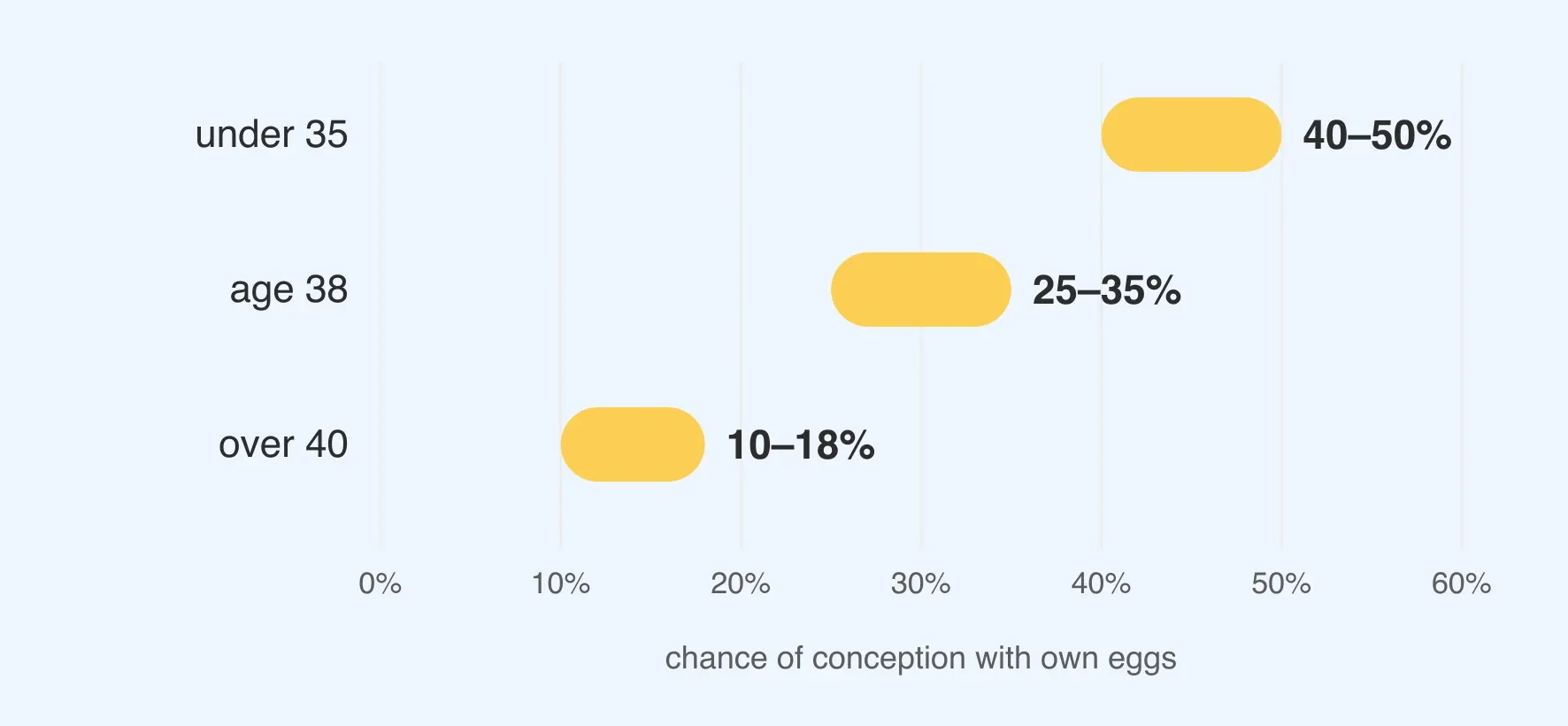
- age and ovarian reserve. After 35 the number and quality of eggs fall sharply. With her own eggs, a woman’s chance of conceiving is about 40–50% before 35, 25–35% at 38 and 10–18% after 40;
- embryo quality. Blastocyst transfer and genetic testing (PGT-A) raise the likelihood of implantation to 60–70%;
- the state of the endometrium — no polyps, adhesions or inflammation, and a transfer timed to the “implantation window”;
- the male factor — in particular DNA fragmentation, which affects embryo development after day 3;
- coexisting conditions — endometriosis, hydrosalpinx, endocrine and immune disorders;
- the laboratory — the embryologists’ experience, selection and cryopreservation technologies.
Technologies that are changing reproductive medicine
- Sperm selection. MACS is a “magnetic trap” that filters out cells with damaged DNA. Microfluidic chips mimic the natural route: the sperm have to swim through a micro-maze on their own, and the best ones reach the exit.
- Robotic ICSI. Automated systems with artificial intelligence select a sperm and inject it into the egg themselves. In 2023 the first children conceived with such a system were born in New York.
- Artificial intelligence in embryo selection. Incubators with continuous video recording (time-lapse) capture every cell division, and algorithms find features in this data that help predict implantation.
- Non-invasive genetic testing (niPGT-A). The embryo’s DNA is analysed in the medium it grew in, without a biopsy, so there is no risk of injuring the blastocyst.
On the horizon
Some methods are still at the research stage. These include injecting platelet-rich plasma (PRP) into the ovaries to “wake up” dormant follicles in premature ovarian insufficiency; stem cells from menstrual blood to repair a damaged endometrium; and mitochondrial replacement therapy, in which the nucleus of the patient’s egg is transferred into a donor egg with healthy mitochondria.
Reproductive medicine in Ukraine
Since 2024, assisted reproductive technologies in Ukraine have been available free of charge under the Medical Guarantees Programme, at facilities that have a contract with the National Health Service of Ukraine (NHSU). According to the figures given in the talk, the programme covers 46 facilities in 13 regions and Kyiv, more than 5,000 women have started treatment under it, and 197 children have been born.
Among the priorities for the future, the speaker names wider access to ART, closer integration of urology and reproductive medicine, and the prevention of infertility through early detection of risk factors and timely treatment.
Key points
- Infertility is a couple’s problem: male and female factors are equally common.
- Seek help after 12 months of trying, or after 6 if you are 35 or older.
- A woman’s age has the strongest effect on IVF success, so do not put off your visit.
- The best results come from a fertility specialist, embryologist and andrologist working as a team.
You can book an appointment with a fertility specialist or an andrologist at Ekstramed in Ivano-Frankivsk.
This article is for information only and does not replace a consultation with a doctor. The plan of tests and treatment is decided by a doctor.
Sources: talk by S. Havryliuk-Chornozub, “Reproductive medicine: from its origins to the present day” (Yaremche, 16–17 October 2026); WHO, Infertility prevalence estimates, 2023; WHO laboratory manual for the examination and processing of human semen, 6th edition, 2021.
More worth reading
More explanations, advice and answers from the doctors of the clinic.
 18/11/2026Technology6 min readThe Applebaum score: how ultrasound and Doppler show whether the uterus is ready for embryo transfer
 01/09/2026Technology7 min readSemen analysis: how to read the result and what to do next
 01/09/2026Technology9 min readHow IVF works: every stage of the programme, step by step
 18/11/2026Advice5 min readAesthetic gynaecology: beauty, comfort and self-confidence
- Technology18/11/20266 min readThe Applebaum score: how ultrasound and Doppler show whether the uterus is ready for embryo transfer
- Technology01/09/20267 min readSemen analysis: how to read the result and what to do next
- Technology01/09/20269 min readHow IVF works: every stage of the programme, step by step
- Advice18/11/20265 min readAesthetic gynaecology: beauty, comfort and self-confidence