
Author: Ekstramed clinic
The Applebaum score: how ultrasound and Doppler show whether the uterus is ready for embryo transfer
When an embryo fails to implant, its quality is often the first suspect. But the success of a transfer also depends on how ready the uterus is to receive it: on the state of the endometrium, the muscular wall and the blood supply. The Applebaum score helps assess this in advance. It is a points system based on a standard transvaginal ultrasound with Doppler.
What the Applebaum score is
The score was proposed by M. Applebaum in 1995 (Ultrasound Obstet Gynecol, 5(1):67–68). It has since been used under two names: the Uterine Biophysical Profile (UBP) and the Uterine Scoring System for Reproduction (USSR).
The idea is simple: instead of a single figure, such as endometrial thickness, the doctor looks at several features at once and combines them into an overall score. The more favourable the conditions, the higher the score. It is used in IVF and ICSI cycles, in frozen embryo transfers and in stimulated intrauterine insemination (IUI) cycles.
What exactly is assessed
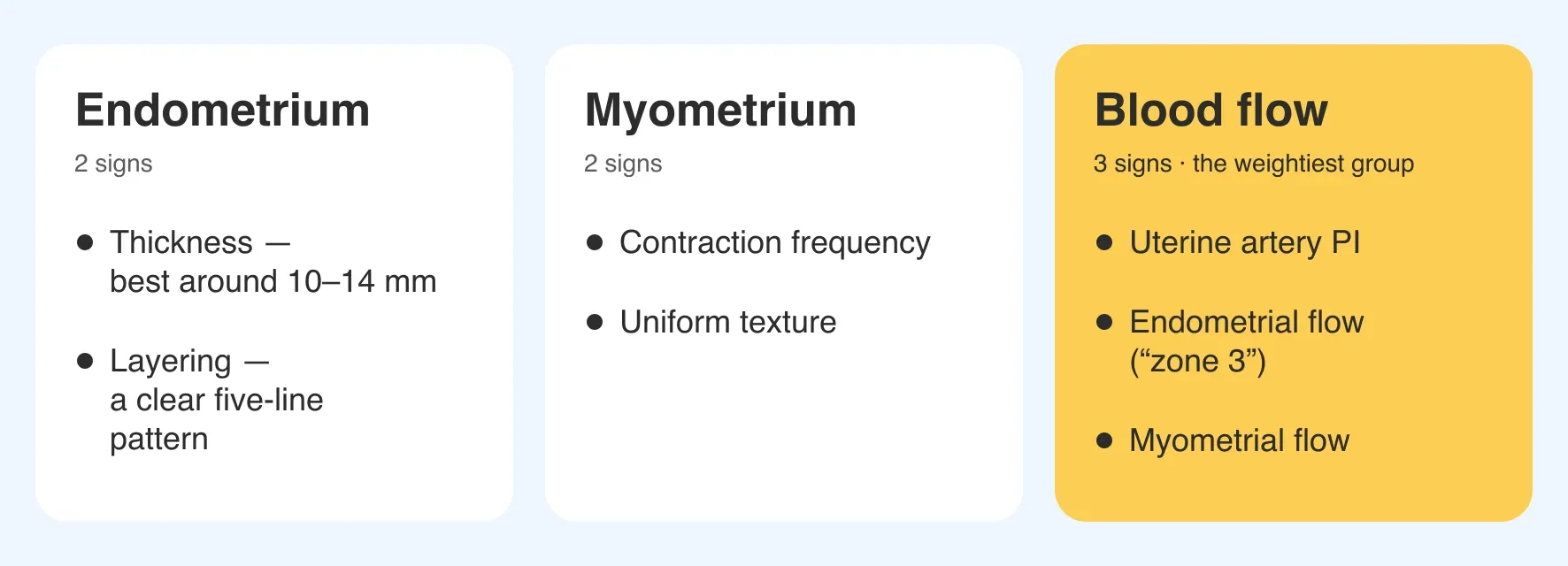
The score brings together seven features, which fall neatly into three groups.
Endometrium
Thickness and layering. A happy medium works best, roughly 10–14 mm: an endometrium that is too thin is poorly prepared, while one that is too thick is not considered ideal either. A clear five-line (layered) pattern is a good sign; a blurred or absent one is less favourable.
Myometrium
How often the muscular wall contracts over a few minutes of observation, and how uniform its structure is: smooth, even tissue is better than coarse, uneven tissue.
Blood flow
The most heavily weighted group. The doctor assesses resistance in the uterine arteries (the pulsatility index, PI), blood flow within the endometrium itself (“zone 3” on the score) and blood flow in the myometrium. The better the blood flow, the more favourable the outlook. In several studies, endometrial blood flow and uterine artery PI were the features most closely linked to pregnancy.
When the assessment is done
The score is usually calculated before embryo transfer: on the day of transfer or at a trial scan beforehand, and in frozen embryo cycles on the day of thawing. Sometimes the middle of the cycle is assessed as well. The state of the uterus changes over the cycle, so the date of the scan and the cycle day are always recorded in the report.
What the research says
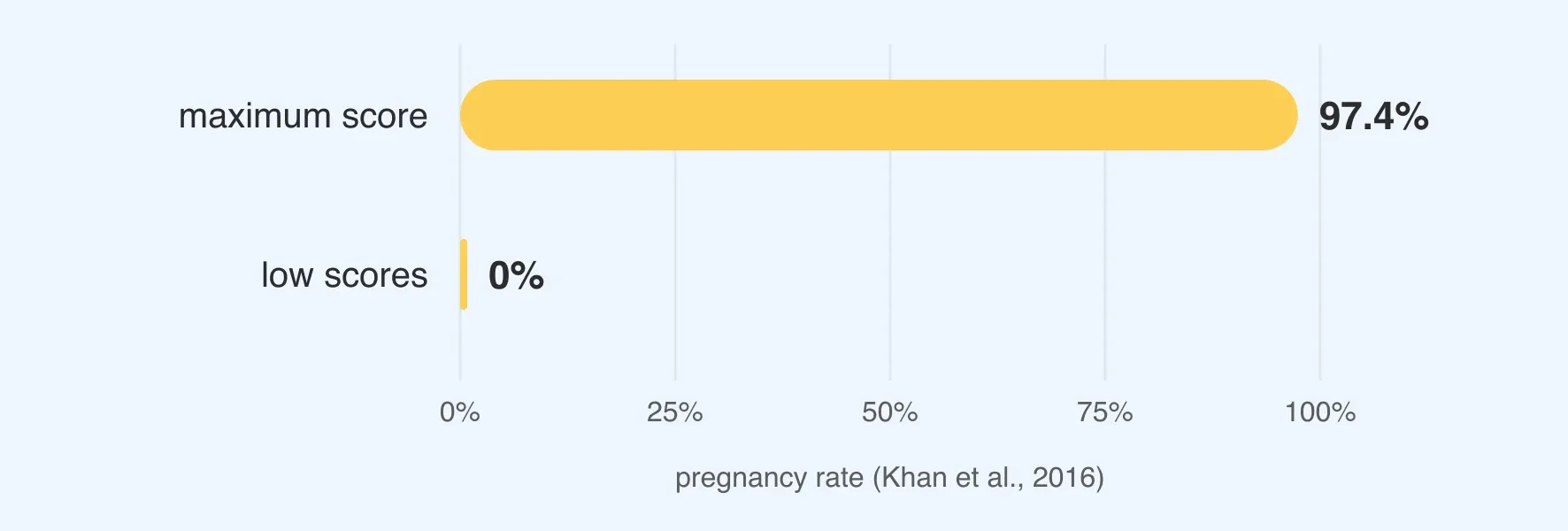
- In the study by Khan et al. (2016), almost every woman with the maximum score became pregnant, 97.4%, while there were no pregnancies at all with low scores. Absent or reversed diastolic flow was not associated with pregnancy either.
- In another study using a modified score, high scores led to more than 85% pregnancies, and intermediate ones to less than a third.
- In a study from Erbil (Zanco J Med Sci, 2022), a high pregnancy rate was linked to an endometrial thickness of 10–14 mm, a clear three-layer pattern, marked endometrial blood flow and a low uterine artery PI. The last two features gave 100% pregnancies in that sample.
- In a study of ICSI and frozen embryo transfer cycles, the score separated cycles that led to pregnancy from those that did not well: sensitivity was about 90% and specificity about 89.5%. In IUI cycles, the overall score and uterine artery PI performed best.
What the score does not do
Thresholds vary from study to study, and the samples are mostly small and varied, so the score cannot give a hundred per cent prediction. It helps choose the strategy and timing: whether to transfer the embryo now or adjust endometrial preparation first. It is not a ban on transfer and not a substitute for clinical judgement.
A separate measure: resistance in the spiral arteries
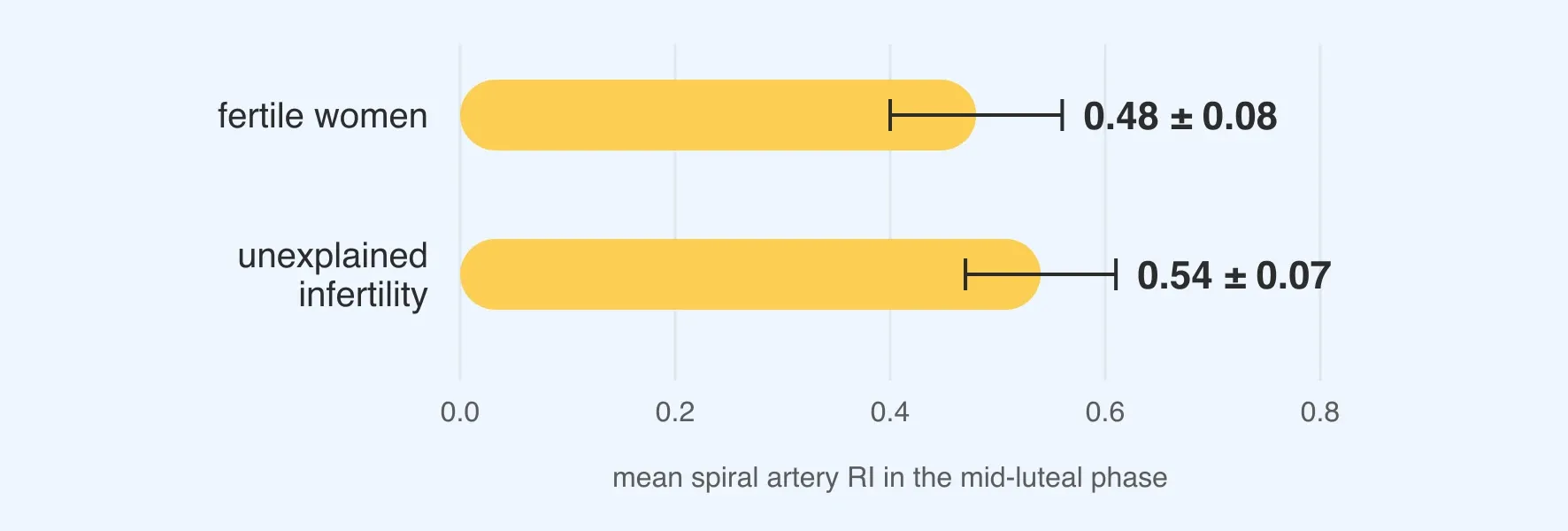
Alongside the main score, we assess the resistance index (RI) in the spiral arteries of the endometrium, taking the cycle day into account. It is lowest in the mid-luteal phase, when the “implantation window” opens. In one study, the mean RI in fertile women at this time was 0.48 ± 0.08, while in unexplained infertility it was higher, at 0.54 ± 0.07. There are no single generally accepted reference values, so this is a supporting measure and is not included in the overall score.
How we use the score at Ekstramed
The clinic’s doctors adapted the score for everyday work and wrote their own calculator, as no ready-made tool existed. It:
- calculates the overall score automatically and shows straight away how to interpret it;
- works out the cycle day from the scan date and the first day of the period;
- assesses spiral artery RI separately according to the cycle phase and indicates whether the scan falls within the implantation window;
- produces a report, either a full one with a table or a short one with the key findings only;
- prints the report on A4 or saves it as a PDF.
The calculator runs right in the browser without an internet connection, so patients’ data are not sent anywhere. It is a supporting tool for the doctor: decisions are always made on the basis of the whole clinical picture.
Frequently asked questions
Do I need to prepare in any way? No. It is a standard transvaginal ultrasound with Doppler, carried out on the day set by your fertility specialist, most often before a transfer.
Does a low score mean the transfer will be cancelled? Not necessarily. The score is a reason to discuss with your fertility specialist whether to transfer the embryo in this cycle or to improve endometrial preparation first.
Does a high score guarantee a pregnancy? No. It means conditions in the uterus are favourable, but the outcome also depends on the embryo and on many other factors.
You can have the endometrium assessed before transfer with an ultrasound with Doppler at Ekstramed; the preparation programme is chosen by a fertility specialist.
This article is for information only and does not replace a consultation with a doctor. Treatment is decided by a doctor after an examination.
Sources:
- Applebaum M. The uterine biophysical profile. Ultrasound Obstet Gynecol. 1995;5(1):67–68.
- Khan MS, Shaikh A, Ratnani R. Ultrasonography and Doppler study to predict uterine receptivity in infertile patients undergoing embryo transfer. J Obstet Gynecol India. 2016;66(1):377–382.
- Ghazi Sedeq M. Role of uterine biophysical profile in predicting conception in a sample of infertile women attending an IVF center in Erbil. Zanco J Med Sci. 2022;26(2).
- Shivtare MV, et al. Uterine scoring system for reproduction: correlation with pregnancy rate in ICSI and frozen-thawed embryo transfer.
- Abunayla RSH, et al. Using uterine biophysical profile as a predictor of endometrial receptivity and pregnancy in stimulated IUI cycles. Iraqi J Embryos Infertil Res. 2019;9(2).
More worth reading
More explanations, advice and answers from the doctors of the clinic.
 18/11/2026Technology9 min readCongenital uterine anomalies: why an accurate diagnosis needs 3D ultrasound
 01/09/2026Technology7 min readAMH and ovarian reserve: which tests really show your chances of pregnancy
 01/09/2026Technology9 min readHow IVF works: every stage of the programme, step by step
 18/11/2026Technology4 min readRectal cancer: when surgery on the bowel can be avoided
- Technology18/11/20269 min readCongenital uterine anomalies: why an accurate diagnosis needs 3D ultrasound
- Technology01/09/20267 min readAMH and ovarian reserve: which tests really show your chances of pregnancy
- Technology01/09/20269 min readHow IVF works: every stage of the programme, step by step
- Technology18/11/20264 min readRectal cancer: when surgery on the bowel can be avoided