
Egg donation: when it is needed, how a donor is chosen and what the chances are
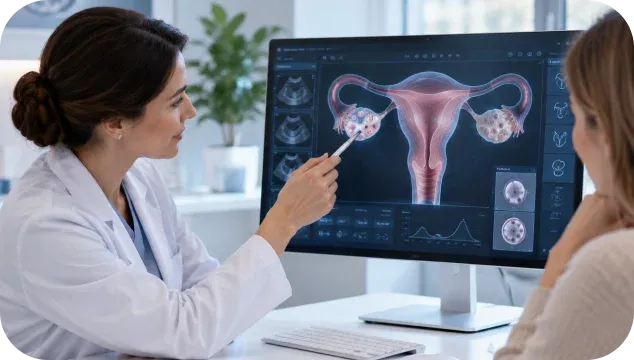
Many people first hear about programmes with donor eggs at the moment they are already worn out. Several failed attempts, the words “the eggs are not of the right quality”, a feeling of closed doors. And then donation looks not like a solution but like surrender.
In practice it is quite different. Egg donation is the method with the highest success rate in all of reproductive medicine. And the calmer and earlier it is talked about, the less pain there is along the way.
What egg donation is
It is a programme in which the eggs for fertilisation come not from the patient but from a healthy young woman — the donor. The eggs are fertilised with the sperm of the patient’s partner (or donor sperm), and the resulting embryo is transferred into the future mother’s uterus.
The woman carries the pregnancy herself. She goes through every stage — from the first ultrasound to the birth — and feeds the baby, and throughout the pregnancy the foetus exchanges signals with her body that influence its development. Legally and in fact, the child’s mother is the woman who gave birth.
Who needs it
The main indications:
- premature ovarian insufficiency — a condition in which the ovaries stop working before 40. Sometimes the cause is known (surgery, chemotherapy, genetics), sometimes not
- exhausted ovarian reserve — a critically low AMH, when stimulation yields no eggs or their number is close to zero
- age over 42–43 with the woman’s own eggs — with age the frequency of chromosomal abnormalities in eggs rises, and the likelihood of a live birth per attempt becomes substantially lower
- a “poor response” to stimulation in several programmes in a row, when one or two eggs are retrieved, or none
- repeated IVF failures due to egg and embryo quality
- menopause, including natural menopause, provided the woman is healthy and can carry a pregnancy
- genetic indications — when the woman carries a disease that cannot be screened out by preimplantation testing
- absence of the ovaries after surgical removal
- the aftermath of cancer treatment, if eggs were not frozen beforehand.
The key decision is always made after a full work-up: first the doctor checks whether the woman’s own eggs have really run out. Donation should not be a “quick fix” instead of proper diagnostics.
Who can be a donor
Requirements for egg donors in Ukraine are set by the regulations of the Ministry of Health and, additionally, by the clinic’s internal standards. The general logic of selection is the same in every serious centre:
- young age — the main criterion, on which egg quality depends
- having a healthy child of her own — a requirement of the current rules on assisted reproductive technology in Ukraine (a number of other countries have no such condition)
- a full medical examination: general health, a gynaecological examination, ultrasound, a hormone profile with AMH
- tests for infections: HIV, hepatitis B and C, syphilis, sexually transmitted infections
- genetic testing — karyotyping and, under the clinic’s protocol, screening for carrier status of common recessive diseases
- no hereditary diseases or serious illnesses in the family
- a psychological assessment and informed, documented consent
- no harmful habits.
The selection has several stages precisely because the outcome of the programme depends on it directly.
The exact requirements current at the time you apply should be checked with the clinic directly: the regulations and internal protocols are updated from time to time.
Anonymous or known donor
Anonymous donation is the standard option. Patients do not know the donor’s personal details, and the donor does not know the patients’. The clinic provides information on the phenotype: hair and eye colour, height, weight, blood group, sometimes education, age and the number of her own children. The match is made by resemblance to the future mother.
Known donation is when a relative or close friend agrees to be the donor. Here the medical side is simpler, while the psychological and legal sides are the reverse, so such programmes require separate preparation and a discussion of all the consequences in advance.
How the programme runs, step by step
1. Consultation and work-up of the patient. The aim is to make sure the woman can carry a pregnancy: the state of the uterus and endometrium, general health and the control of chronic illnesses are assessed. In parallel the partner has a semen analysis and tests for infections.
2. Choosing the donor. By phenotype, blood group and medical criteria. Many centres have a bank of frozen (vitrified) eggs — that speeds up the start of the programme, since there is no need to wait for the cycles to synchronise.
3. Stimulation of the donor and retrieval. The donor goes through the same stages as any IVF patient: stimulation, ultrasound monitoring, egg retrieval under sedation. The patient does nothing at this point.
4. Fertilisation. The eggs retrieved (or thawed from the bank) are fertilised with the partner’s sperm — usually by ICSI, which gives the best control over the process. The embryos are cultured for 5 days to the blastocyst stage.
5. Preparing the patient’s endometrium. This is the only stage in which the future mother takes an active part: oestrogen and progesterone preparations, and a few ultrasounds to check the thickness and structure of the endometrium. The “implantation window” is prepared.
6. Embryo transfer. A short procedure without anaesthesia; usually one embryo is transferred. The rest are frozen — they provide the next attempts or the possibility of a second child.
7. Pregnancy test — β-hCG after about 10–14 days. Then progesterone support and ordinary pregnancy care.
8. Preimplantation testing — by choice and where indicated, the embryos can be tested for chromosomal abnormalities before transfer. More in the genetic diagnostics section.
The overall duration is roughly 1.5–2 months from the start to the test, faster when vitrified eggs from the bank are used.
What the chances of success are
This is the strongest argument for the method. Because the eggs come from a young healthy woman, the patient’s age has almost no effect on the outcome — provided the uterus is healthy.
The pregnancy rate per blastocyst transfer in programmes with donor eggs is roughly 45–55%, and cumulatively, over several transfers from one programme, substantially higher. For comparison: a woman’s own eggs after 42 give single-digit percentages.
The doctor will give exact expectations for your case after the work-up: the state of the endometrium, weight, concurrent illnesses and the partner’s semen analysis all matter.
The psychological side: it is worth talking about
The hardest question is usually not medical but personal: “will it be my child”. There is no universal answer, but there are things worth bearing in mind.
- The decision needs time, not haste. It is normal to think for months
- it is a decision for two people. Often one partner is ready and the other is not, and it is much easier to talk that through before the programme starts than after
- a consultation with a psychologist who works with fertility issues is not a sign of weakness but a sensible tool
- whether to tell the child about their origins is for each family to decide. Modern specialists lean towards openness in an age-appropriate form, but nobody has the right to pressure you here
- the pregnancy and the birth will be entirely yours — with the first heartbeat on the ultrasound, the kicks, the sleepless nights and all the rest.
Many patients later describe this stage like this: the hardest part was making the decision, and after it things became easier than they had been before.
Frequently asked questions
Will the child look like me? The donor is matched by phenotype — hair and eye colour, facial type, height, blood group. Besides, the partner’s genetics take part in forming the child. Resemblance within families is, in general, unpredictable.
Can I choose the donor myself? Patients are given information about the candidates’ phenotypic and general characteristics without personal data. The scope of that information is set by the clinic in line with the law.
How much does the programme cost? The cost depends on whether fresh or vitrified eggs are used, whether ICSI or PGT is needed, and how many transfers the programme is designed for. Package offers are in the prices section.
Is there an age limit for the patient? The medical decision is made individually, taking into account the woman’s health and her ability to carry a pregnancy safely. Limits exist and have a medical basis — pregnancy at an older age carries higher risks.
Can the donor later claim the child? No. The donor signs documents waiving any rights and obligations towards children born as a result of the programme. The parents are the patients.
Do I have to tell relatives? No. Medical information is confidential, and the decision on whom to share it with is yours alone.
Where to go in Ivano-Frankivsk? The egg donation programme is run by the Ekstramed clinic — from the work-up and choice of donor to embryo transfer and pregnancy care. Details in the egg donation programme section, booking in contacts.
This article is for information only and does not replace a consultation with a doctor. The indications, the scope of the programme and the requirements for donors are determined individually and in accordance with the current legislation of Ukraine.
More worth reading
More explanations, advice and answers from the doctors of the clinic.
 01/09/2026Technology7 min readPrenatal screening and NIPT: a week-by-week calendar of tests in pregnancy
 01/09/2026Technology9 min readHow IVF works: every stage of the programme, step by step
 01/09/2026Preparation7 min readPreparing for pregnancy: which tests a couple should have before conceiving
 01/09/2026Technology7 min readAMH and ovarian reserve: which tests really show your chances of pregnancy
- Technology01/09/20267 min readPrenatal screening and NIPT: a week-by-week calendar of tests in pregnancy
- Technology01/09/20269 min readHow IVF works: every stage of the programme, step by step
- Preparation01/09/20267 min readPreparing for pregnancy: which tests a couple should have before conceiving
- Technology01/09/20267 min readAMH and ovarian reserve: which tests really show your chances of pregnancy